 XRT
Evaluating Lightweight Contact Feedback in Dual-Operator Collaborative Humanoid Teleoperation
1Symbiotic and Augmented Intelligence Lab · 2Robot Danger Lab · Georgia Institute of Technology
What this study is, and how it relates to XRT
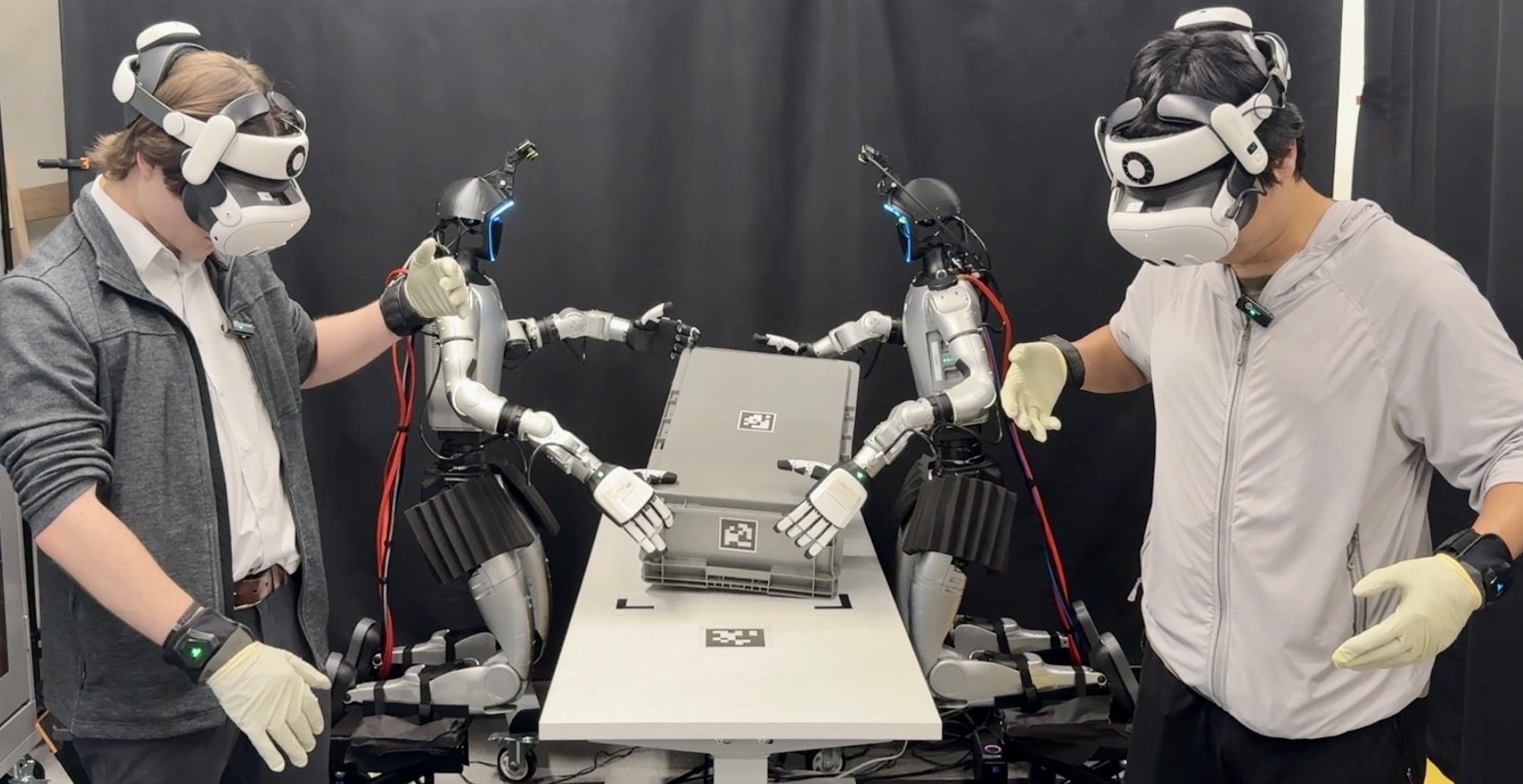
XRT connects one operator to one robot. For this study we built a dual-humanoid testbed on XRT: two XRT stations run in lock-step, a master laptop broadcasting study actions to its peer for execution at a shared epoch, so two operators each drive a Unitree G1 and manipulate one crate together. Conditions switch on both stations at once, clocks are aligned (median offset 2.1 ms, maximum 46 ms), and every take is logged for a synchronized replay. The results below concern this two-operator setting and our two cue designs, not XRT in general. The study software (operator manager, lock-step link, recording and digital twin) is in proj_XRT; the headset app is XRT-Client.
Abstract
Dual-operator humanoid teleoperation enables collaborative manipulation through two separate robots, but operators lack direct awareness of robot–object contact that is normally available during physical interaction. To address this, we present eXtended Reality Teleoperation (XRT), an extended reality teleoperation framework that returns a robot's fingertip contact through lightweight vibrotactile and/or auditory feedback, and a synchronized dual-humanoid testbed built on it for two operators. Sixteen dyads performed a collaborative crate lift-and-flip under vision only and the three feedback conditions in a counterbalanced within-subject design with verified feedback-channel delivery. Three results follow. First, operators rated our finger-localized vibrotactile display as more effective than our open-ear sonification: all 32 ranked it above the sonification, 18 ranked it most effective, and its cues were rated far easier to perceive and interpret than the auditory cues. Second, completion time, failures, workload, discomfort, and partner awareness showed no detected condition differences, with wide completion-time intervals and smaller meaningful effects unresolved. Third, performance changed substantially with practice, especially on the harder flip-over task: completion time improved across blocks, and attempt-to-attempt variation within a dyad (SD ×1.51) was larger than the largest condition contrast (×1.16). Exploratory analyses detected no difference in immediate grip or motion responses between feedback conditions. For novice collaborative teleoperation, our fingertip vibrotactile cues were rated more effective and easier to interpret than our auditory cues, while their effect on task performance remains unresolved.
Study design
Pairs lifted a rigid crate (61×38 cm, 1.68 kg), inverted it 180° and returned it to the marked area: attempt 1 flips it over, attempt 2 flips it back. Each robot supports one side, so mismatched motions pass through the object and one partner must stabilize it while the other rotates it. Operators stood behind a curtain and saw the scene only through the headset's stereo feed.
Four conditions form a 2×2 (tactile × audio) factorial added to stereo video: V, A+V, T+V and T+A+V, run in a 4×4 Williams square. Each block had a per-finger cue demonstration, 2 minutes of free practice, two recorded attempts, then NASA-TLX, discomfort and partner-awareness ratings.
Result 1: vibrotactile cues were rated more effective and easier to interpret
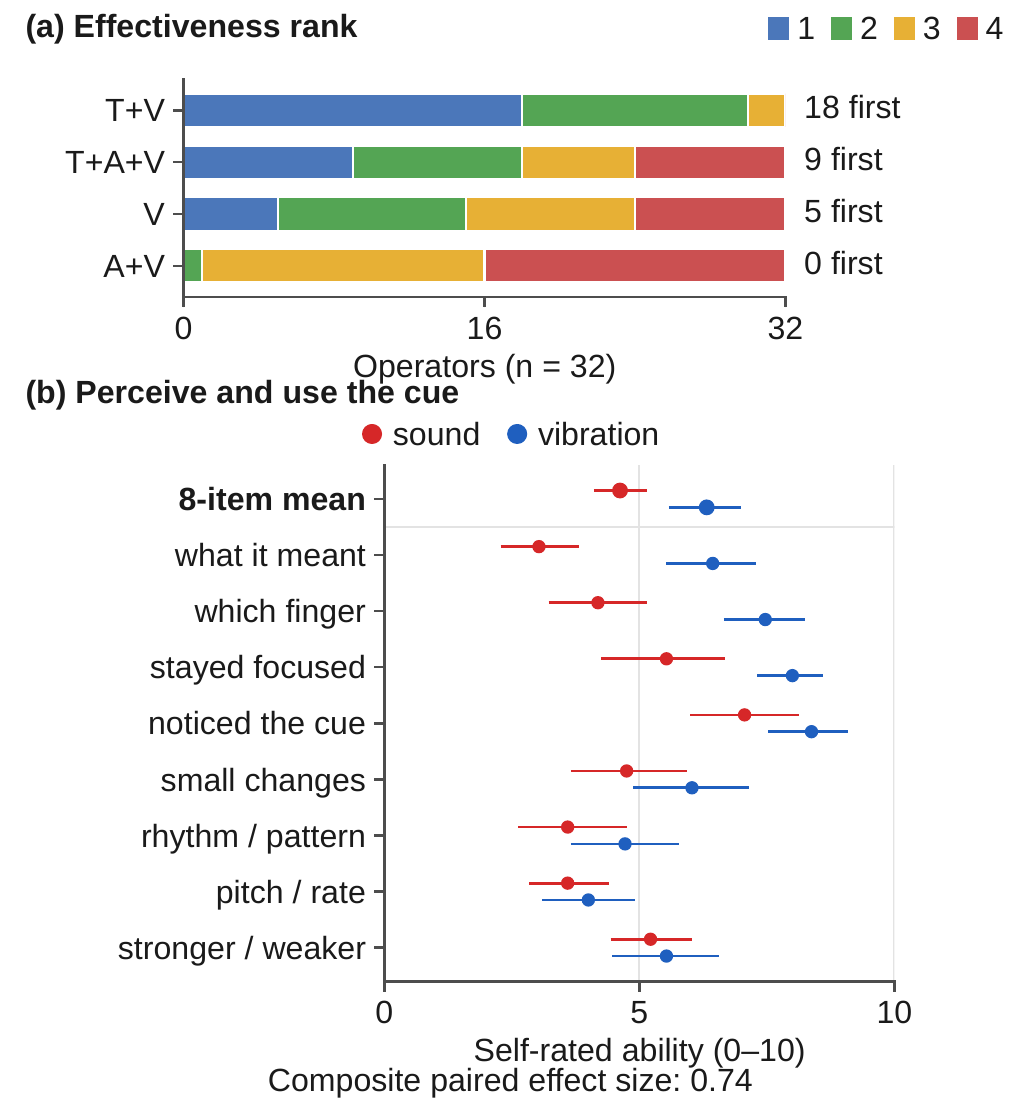
The effectiveness ranking was decisive (Friedman, dyad-permutation p < .001). T+V was ranked most effective by 18 of 32 operators, T+A+V by 9, V by 5 and A+V by none, and every operator ranked T+V above A+V. Across eight perception items the vibrotactile cues scored 6.32 vs 4.62 for the auditory cues (dz = 0.74), most of all for telling what a cue meant (6.44 vs 3.03) and which finger it referred to (7.47 vs 4.19).
Result 2: no detected objective condition effect
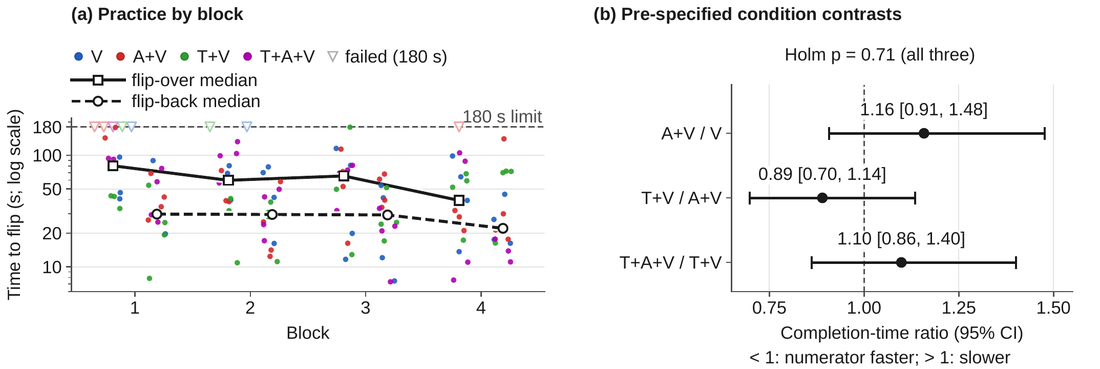
Completion time did not differ detectably between conditions (mixed-model LRT p = .55). The pre-specified contrasts were A+V/V ×1.16 [0.91, 1.48], T+V/A+V ×0.89 [0.70, 1.14] and T+A+V/T+V ×1.10 [0.86, 1.40] (Holm p = .71). Workload, discomfort and partner awareness did not differ detectably either. The approximate minimum detectable completion-time effect was large (45% at 80% power), so smaller effects remain unresolved; these null tests do not establish equivalence.
| Outcome (16 dyads, 32 operators) | V | A+V | T+V | T+A+V | Test, p |
|---|---|---|---|---|---|
| Completion time, median (s) | 55.6 | 64.9 | 57.6 | 62.5 | LRT .55 |
| Failed attempts (of 32) | 2 | 3 | 2 | 1 | Cochran's Q .78 |
| NASA-TLX (0–100) | 39.1 | 38.3 | 37.6 | 38.4 | LRT .95 |
| Discomfort (0–10) | 4.98 | 4.62 | 4.86 | 5.12 | LRT .60 |
| Partner awareness (1–5) | 3.75 | 3.81 | 4.00 | 3.78 | LRT .35 |
| Effectiveness rank (1 = most) | 2.62 | 3.47 | 1.50 | 2.41 | Friedman <.001 |
| Ranked most effective (n) | 5 | 0 | 18 | 9 |
Failures enter time models at the 180 s limit.
Result 3: the practice effect exceeded the largest feedback estimate
Time to flip complete fell 25% per block on the flip-over (finished-attempt medians 81, 60, 65 and 39 s), while no flip-back slope was detected. The largest feedback point estimate (×1.16) is smaller than one block of practice (×0.75–0.81) and far smaller than the attempt-to-attempt scatter within a block (SD ×1.51). This is a design observation, not an explanation of the null: novice feedback studies need to account explicitly for training state.
Also measured (exploratory)
- Cue coverage, the fraction of digital-twin contact time with a tactile level registered, averaged 0.70; 29% of contact time involved non-hand links.
- No resolved difference in the immediate whole-hand activation response to cues with vibrotactile output on vs off (+103 counts, 95% CI [−100, +295]).
- 18 of 32 operators reported substantial cybersickness, with higher workload and lower usability (SUS 57.5 vs 68.8), but no detectable difference in dyad time or in the condition they ranked most effective.
Citation
@misc{graves2026evaluating,
  title  = {Evaluating Lightweight Contact Feedback in Dual-Operator
            Collaborative Humanoid Teleoperation},
  author = {Graves, Austin and Kong, Chuizheng and Cho, Yunho and Yang, Yuanshao
            and Nidumukkala, Advaith and Kousik, Shreyas and Moghaddam, Mohsen},
  year   = {2026},
  note   = {Preprint},
  url    = {https://xrt-teleop.github.io}
}
XRT's retargeting builds on SEW-MIMIC; please also cite Kong et al. when using it.